
Establishing A State Religion?
“If there is any fixed star in our constitutional constellation, it is that no official, high or petty, can prescribe what shall be orthodox in matters of politics, nationalism, religion, or other matters of opinion or force citizens to confess by word or act their faith therein.”
—Justice Robert Jackson,
West Virginia State Board of Education v. Barnette,
319 U.S. 624, 642 (1943)
Last month we witnessed the latest in a series of the government initiatives to enshrine Christian nationalism in federal government operations and policy. Organized by Freedom 250, a nonprofit subsidiary of the National Park Foundation, “Rededicate 250: A National Jubilee of Prayer, Praise & Thanksgiving” flooded the National Mall with “Scripture, testimony, prayer and rededication of our country as One Nation to God.”
The Constitution and the First Amendment expressly protect religious freedom and prohibit any state establishment of religion. But channeling the many constitutional amendment movements in the nation’s history that have sought—unsuccessfully—to inject Christianity into the Constitution, the President’s administration has steadily poured Christian nationalism into government practice.
From the Pentagon to the Department of Agriculture, references to Jesus, prayer, the Bible and “our Christian nation” have become common and the consequences are not cosmetic. When government replaces democratic principles of diversity, equity and inclusion with a narrow and sectarian religious vision, religious freedom and social tolerance become targets and religious bigotry the result.
Public schools may be obligated to teach the Bible and display the Ten Commandments under the guise of “religious literacy.” Certain houses of worship once shielded from ICE raids may be singled out as enforcement targets. Religious beliefs antithetical to democratic principles may be permitted to shield discriminatory conduct.
In February, Defense Secretary Hegseth invited a Christian nationalist pastor who supports repealing women’s right to vote and believes homosexuality should be a crime to lead a session of a monthly prayer series he started.
In April, Agriculture Secretary Brooke Rollins emailed a “Christ is Risen” Easter message to each of the department’s 100,000 employees.
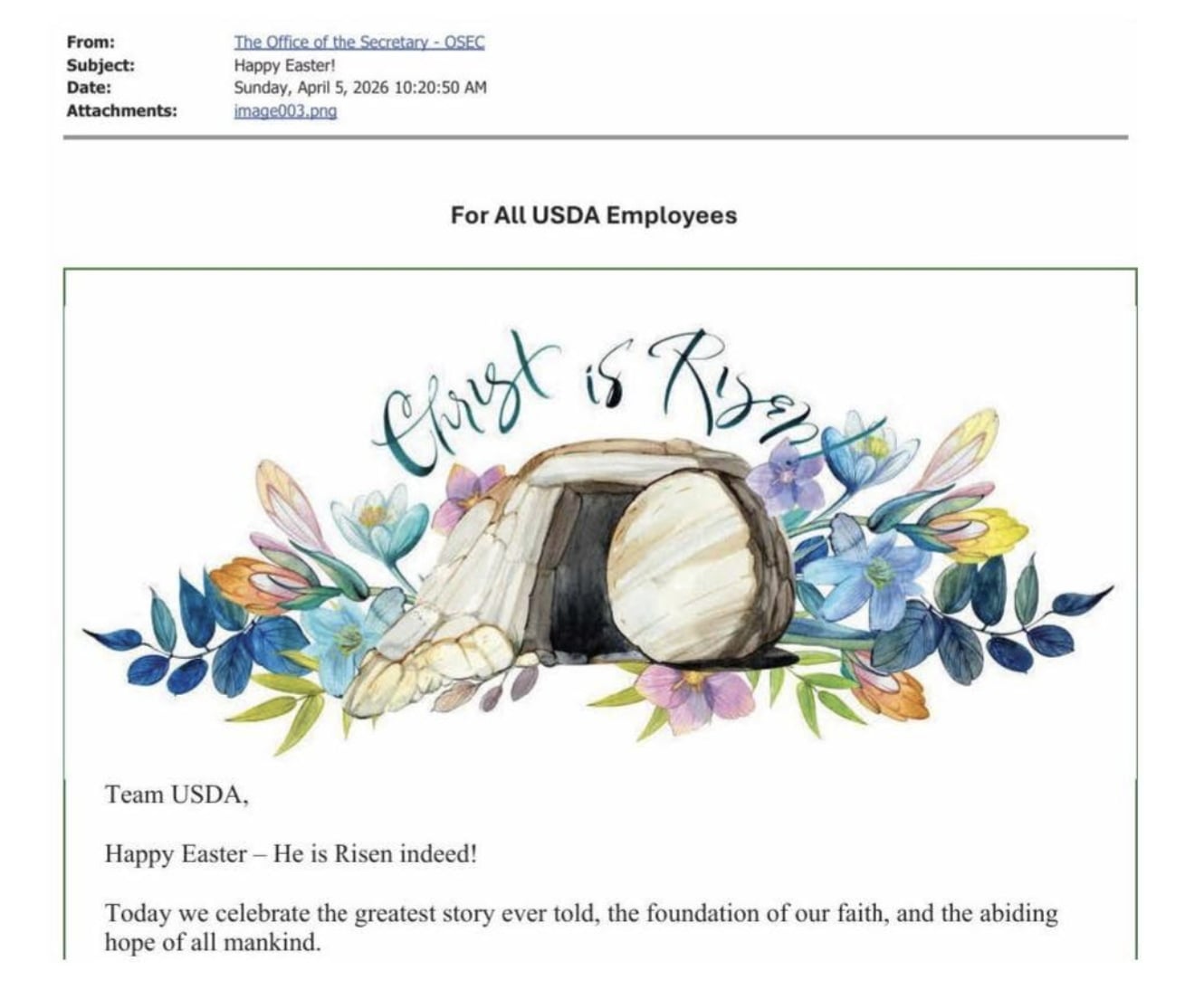
Rollins’ email sparked employee backlash and a lawsuit, contending that it is “exactly the sort of government-sponsored religious coercion, religious sermonizing, and denominational preference that the Establishment Clause prohibits.”
The “Christ is Risen” lawsuit has not yet been resolved. But there is no doubt that the basic constitutional principle on which the challenge is based—the separation of church and state—has been undermined by years of decisions by the conservative majority of the United States Supreme Court, particularly in cases involving conservative Christians.
A look back at two high school football fields, one just outside Atlanta, illustrates the Court’s path.
In 1985, a member of the Douglas County, Georgia high school marching band objected to the school starting home football games with an invocation. The county defended the practice as one designed “to satisfy the genuine, good faith wishes on the part of a majority of the citizens of Douglas County to publicly express support for Protestant Christianity.”
Represented by Atlanta lawyer and later State Bar of Georgia president Jeff Bramlett, the band member brought suit and won. In striking the practice, the Eleventh Circuit cited a long chain of Supreme Court Establishment Clause precedent, and, in 1989, the Supreme Court denied review.
Some thirty years later, outside of Seattle, a high school football coach insisted he had a right to take center field at each game’s conclusion and lead students in a circle of demonstrative prayer. A federal district court and the Ninth Circuit disagreed, explaining that “the facts in the record utterly belie [the coach’s] contention that the prayer was personal and private.”
Justice Sotomayor, joined by Justices Breyer and Kagan, would have affirmed, declaring that this case “is about … a longstanding practice of the employee ministering religion to students as the public watched.”
But the Court’s 6-3 conservative majority disagreed. In a decision expressly overruling much of the Establishment Clause precedent that had been relied upon by the Eleventh Circuit, Justice Gorsuch mocked the school district for firing the coach, a practicing Christian, over “phantom constitutional violations,” stating:
Respect for religious expressions is indispensable to life in a free and diverse Republic—whether those expressions take place in a sanctuary or on a field, and whether they manifest through the spoken word or a bowed head.
The Douglas County marching band member and his family suffered ostracism, threats and vandalism. He went on to pursue a graduate degree in earth sciences from Georgia Tech. The Washington coach was reinstated to his position and received a nearly $2 million settlement. After coaching one game, he resigned, stating “I believe I can best continue to advocate for constitutional freedom and religious liberty by working from outside the school system so that is what I will do.” You can hear his story, buy his book and visit his store at coachjoekennedy.com.
Meanwhile, in late April, a United States Department of Justice “Task Force to Eradicate Anti-Christian Bias” issued a 200-page report. Acting Attorney General Todd Blanche declared, “As our report lays out, the Biden Administration’s actions devastated the lives of many Christian Americans. That devastation ended with President Trump.”
The report treats policy disagreements on many issues such as abortion, LGBTQ rights, education, and public health as evidence of anti-Christian bias. Such treatment raises the troubling prospect that the government has moved beyond safeguarding religious freedom and toward establishment of Christianity as the national faith.
Additional Statements
Federal judges say they’re facing intensified threats since start of Trump’s second term
“Things have gotten so much more dangerous,” a federal judge said in an interview with POLITICO. “I think we are headed in the wrong direction.” GLRL is gravely concerned with the increased threats against judges and the Rule of Law. Judges must be allowed to do their...
Can Jay Clayton 2.O Be Trusted to Stand Up to the President?
The Jay Clayton who chaired the Securities and Exchange Commission would make a perfect Director of National Intelligence (DNI). Jay, who was my boss at the SEC, was someone who pulled no punches and always spoke the truth. Those are crucial qualities for the vital...
The Warning Lights Are Flashing for November’s Elections
Signs that the Trump administration plans to interfere with the midterm elections in November abound. His primetime speech last month sounded the alarm, alleging Chinese meddling, droves of foreigners registering to vote, and an election system perilously vulnerable...
A Threat to the Midterm Elections
There are a few words in Article I of the Constitution that you probably never paid attention to but could be tremendously important in the midterm elections. I became aware of them last year while writing Stealing Elections, American Style. One of the chapters in...
Join Us
We are building a coalition of Georgia attorneys who are committed to the Rule of Law. Please fill out the form if you would like to be part of our initiative to preserve the Rule of Law.
Contact Us
Do you have questions or need to speak with GLRL? Email info@georgialawyersfortheruleoflaw.org, and we'll get back to you as soon as we are able.